| Plant group and examples | DLI target (mol/m²/day) | PPFD for 12 h (µmol/m²/s) | PPFD for 16 h (µmol/m²/s) | Source |
|---|---|---|---|---|
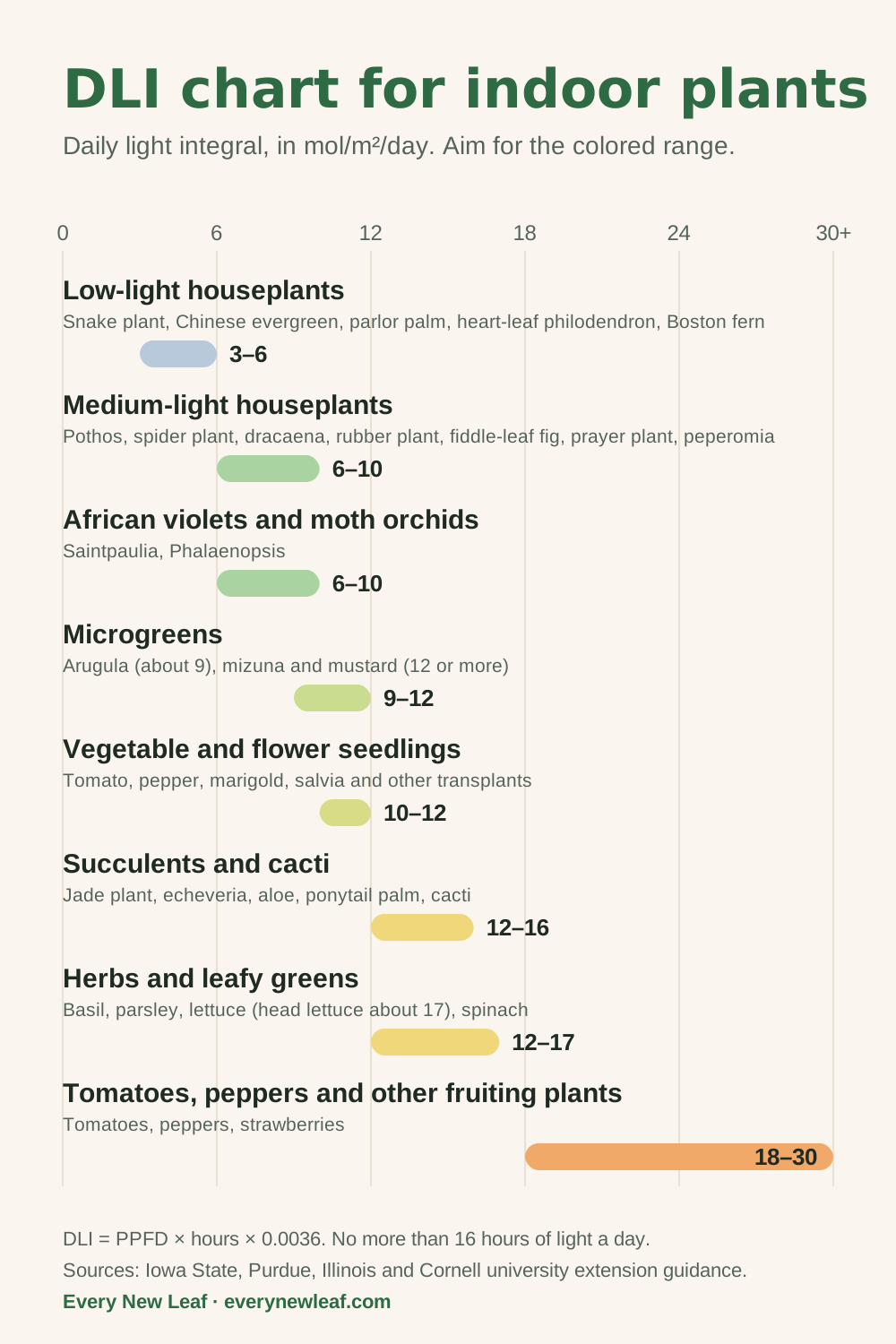
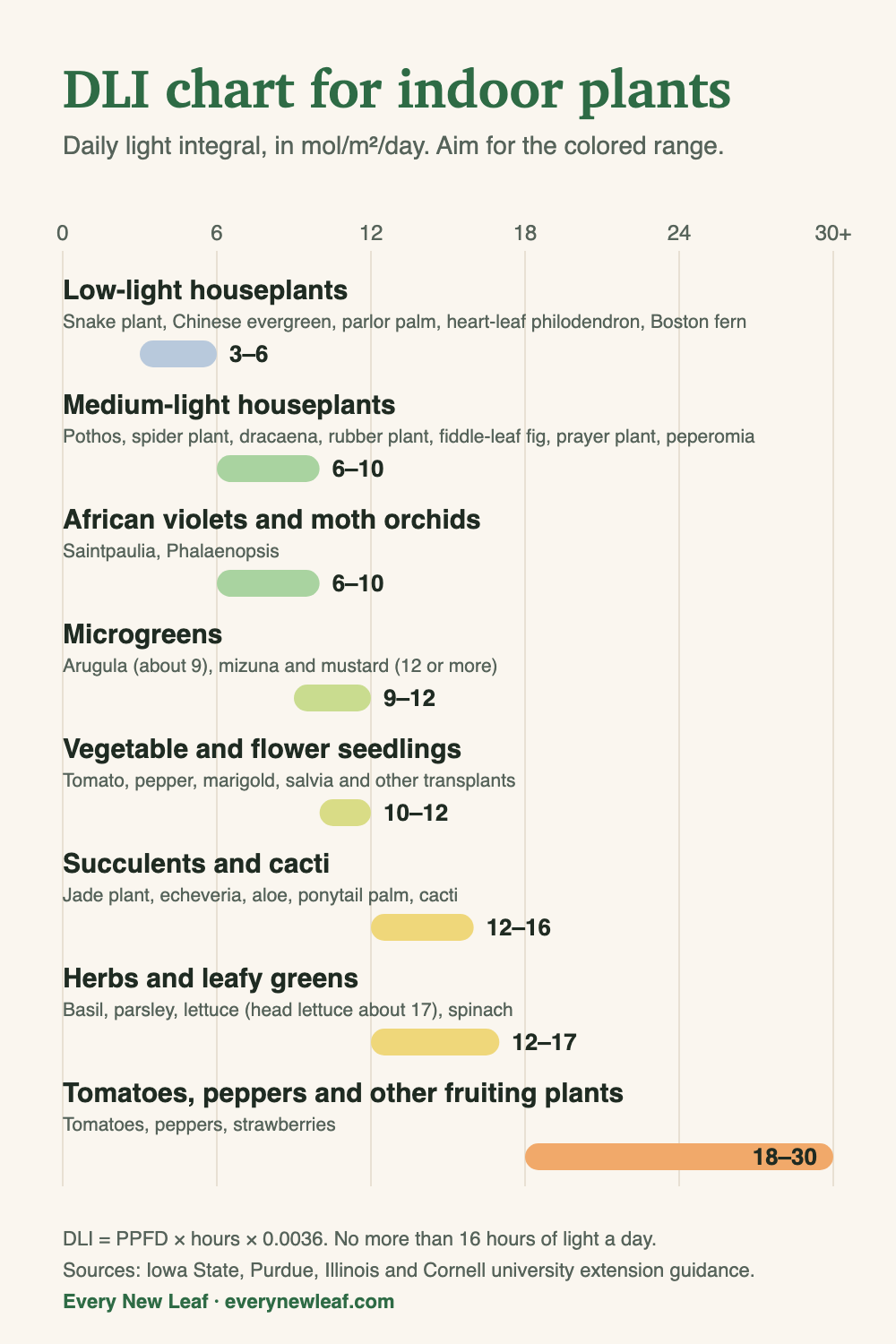
| Low-light houseplants Snake plant, Chinese evergreen, parlor palm, heart-leaf philodendron, Boston fern | 3–6 | 69–139 | 52–104 | Iowa State |
| Medium-light houseplants Pothos, spider plant, dracaena, rubber plant, fiddle-leaf fig, prayer plant, peperomia | 6–10 | 139–231 | 104–174 | Iowa State |
| African violets and moth orchids Saintpaulia, Phalaenopsis | 6–10 | 139–231 | 104–174 | Purdue |
| Microgreens Arugula (about 9), mizuna and mustard (12 or more) | 9–12 | 208–278 | 156–208 | Cornell |
| Vegetable and flower seedlings Tomato, pepper, marigold, salvia and other transplants | 10–12 | 231–278 | 174–208 | Purdue |
| Succulents and cacti Jade plant, echeveria, aloe, ponytail palm, cacti | 12–16 | 278–370 | 208–278 | Iowa State |
| Herbs and leafy greens Basil, parsley, lettuce (head lettuce about 17), spinach | 12–17 | 278–394 | 208–295 | Iowa State |
| Tomatoes, peppers and other fruiting plants Tomatoes, peppers, strawberries | 18–30 | 417–694 | 313–521 | Iowa State |
How to read the table
Stay inside the range for steady, healthy growth. Below the low end, plants stretch toward the light, grow slowly, lose lower leaves and flower poorly. Well above the high end, sensitive leaves can bleach or scorch, especially if the light is very close.
The PPFD columns tell you what to look for on a grow light’s chart at the distance you plan to hang it. For example, basil at 14 hours needs about 238–337 µmol/m²/s.
Notes on specific groups
Houseplants
Plant examples follow University of Illinois Extension’s light lists. Purdue University lists several foliage plants, African violets and moth orchids as acceptable from a DLI of about 2–4, with the best quality at 6–10.
Seedlings
Purdue found seedling quality improved as DLI increased up to about 12. Iowa State places seedlings between the upper medium and lower high range.
Microgreens
Cornell University research found arugula may benefit from a DLI up to about 9, and mizuna and mustard from 12 or more. Microgreens need less light than head lettuce, which grows best at about 17.
Tomatoes and peppers
These need the most light of any common indoor crop. Purdue lists a minimum of about 10–12 and good growth at 14–20, while Iowa State puts fruiting crops at 18–30. Most people can’t reach these levels from a window and need a strong grow light.
Check your own plant with the calculator, or read how many hours to run your grow light.
Sources
- Iowa State University Extension: Important considerations for providing supplemental light to indoor plants
- Torres & Lopez, Purdue University Extension HO-238: Measuring daily light integral in a greenhouse
- University of Illinois Extension: Houseplants, lighting
- Allred & Mattson, Cornell University, in Produce Grower: Dialing in microgreens production